
How Port of Açu Connected Companies, Workers, and Emergency Operations into a Single Digital Platform
The Challenge
Port of Açu brings together dozens of independent enterprises, thousands of workers, and round-the-clock industrial operations. In an environment of this magnitude, critical information must reach the right personnel instantly.
Prior to CORE, communications were fragmented across disconnected channels. Crucial safety alerts, operational updates, service announcements, and emergency notices were distributed in an ad-hoc manner, making it difficult to guarantee synchronized, rapid delivery across the complex.
Simultaneously, workers had to navigate multiple informal contacts simply to locate basic port services, file incident reports, or request emergency assistance during their daily shifts.
The challenge was not merely launching a mobile app—it was engineering an integrated digital hub uniting the entire Port of Açu community to make communication instantaneous and incident reporting seamless.
The Context
Port of Açu functions as an industrial city.
Independent concessionaires, maritime operators, corporate contractors, technical visitors, and specialized emergency response teams all share the same physical infrastructure.
While administrative staff need daily service schedules, field operators rely on real-time safety alerts. In emergency situations, every second counts, and emergency dispatches cannot rely on word-of-mouth or informal telephone chains.
Beyond informational publishing, the solution needed to become the primary daily touchpoint for anyone operating within the port perimeter.
The Idea
The core concept was consolidating everything vital to daily port operations into a unified digital experience.
Rather than scattering notices across bulletin boards and messaging groups, CORE brings news, critical alerts, directory services, emergency reporting, and operational utilities into one integrated interface.
While the mobile app directly empowers on-site workers, a centralized administrative portal provides port authorities with the tools to publish content, monitor emergency telemetry, and govern communications.
The rationale was simple: the faster workers can find information and trigger emergency help, the safer and more efficient the entire port becomes.
The Real Barriers
The primary design hurdle was serving vastly diverse user personas within the same platform.
A resident contractor needed daily port news and shuttle schedules. A dock worker needed to trigger an immediate industrial SOS call. Meanwhile, port command teams needed to broadcast urgent weather alerts and track engagement metrics.
Furthermore, several features depended on integrating legacy operational infrastructure, including direct telephony dispatch lines, meteorological sensor APIs, and maritime logistics feeds.
The platform had to bridge these backend integrations seamlessly, delivering an effortless user experience despite complex industrial machinery operating beneath the surface.
It was equally imperative that emergency push notifications reached workers instantly, even when the application was closed in the background.
The Solution: CORE
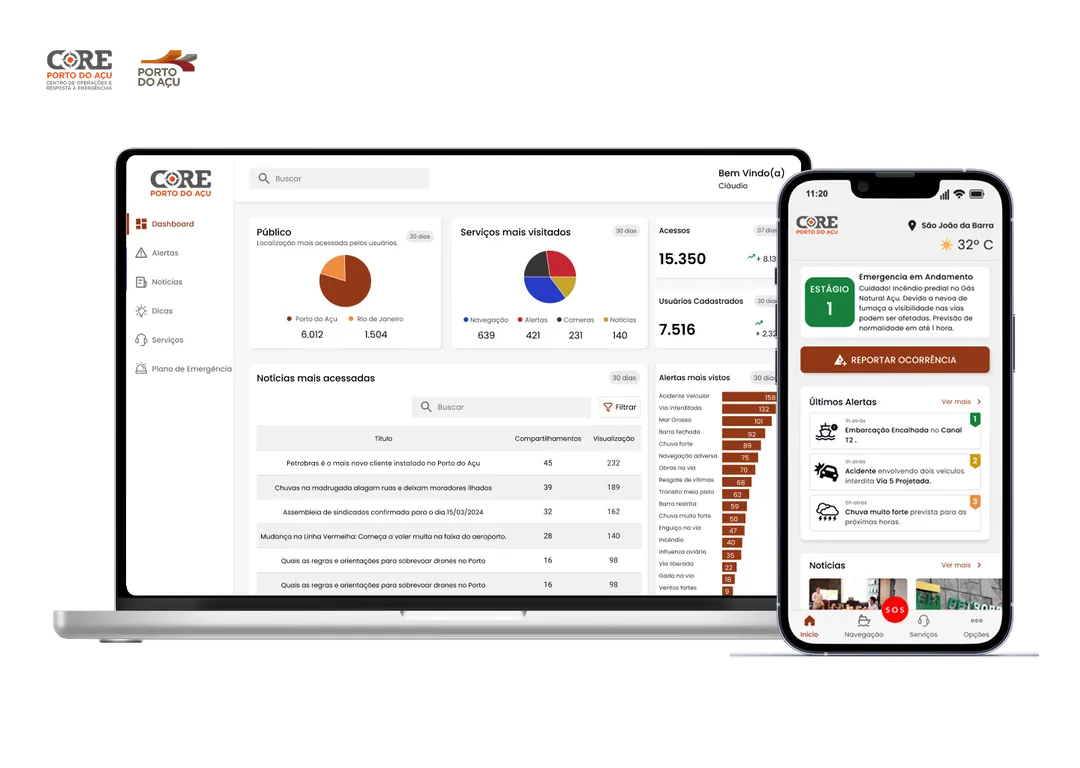
CORE was developed as a unified ecosystem featuring native iOS and Android apps for field users and a web administration console for Port of Açu's Emergency Operations and Response Center.
Through the mobile application, workers access news, safety advisories, operational guidelines, and port service directories. They can also submit incident reports and trigger one-touch SOS distress calls routed directly to the live command dispatch center.
Low-latency push notifications ensure critical weather and safety alerts reach all on-site personnel immediately, regardless of app state.
Meanwhile, the administrative console allows operators to publish announcements, target specific facility zones, analyze engagement KPIs, and manage incidents within a single operational command view.
The result is a connected port community prepared to respond rapidly to emergencies and keep all stakeholders synchronized.
Technical Architecture
The architecture consists of two interconnected applications: native mobile apps distributed via the Apple App Store and Google Play, and an enterprise web administration portal.
The administration portal centralizes content publishing, notification dispatching, telemetry monitoring, and usage analytics.
The mobile app synchronizes with these services in real time, incorporating push messaging, incident logging, dedicated SOS dispatch integration, and live meteorological feeds via weather API integrations.
This modern stack allows operational bulletins to distribute instantaneously, keeping thousands of field personnel and command center operators linked to a single verified source of truth.
User Experience (UX)
The interface was designed to minimize the time required to access critical information or trigger emergency response.
From the home screen, users immediately view high-priority advisories and relevant port news. Essential safety tools, particularly the high-visibility SOS button, remain permanently accessible for instant activation in emergencies.
Navigation is straightforward, allowing regular contractors and first-time maritime visitors alike to locate facilities, phone directories, and weather conditions without requiring training.
For administrative teams, the console provides full autonomy to author bulletins, monitor user reach, and target specific port facilities without requiring engineering intervention.
What Truly Changed
CORE evolved from a mobile app into the central nervous system connecting Port of Açu with its entire community.
The platform now connects over 22 independent enterprises operating across the port perimeter, fostering unified operational coordination.
More than 40 operational personnel experienced a marked reduction in manual overhead previously consumed by repetitive telephone dispatching and bulletin distribution.
Furthermore, the architecture was engineered to support a community of over 7,000 potential users, ensuring smooth scalability as new industrial tenants join the port.
Key Learnings
The project proved that operational communications depend less on how fast an alert is written and far more on how easily it reaches the right individuals.
Another key insight was that safety-critical features, such as emergency SOS triggers, must reside directly on the primary interface rather than tucked away in navigation submenus.
It was equally evident that digital platforms unlock maximum value when consolidating diverse needs. Users do not want one app for weather, another for directory contacts, and a third for emergencies. They expect a single, unified point of contact.
Ultimately, CORE's greatest achievement was not merely digitizing communications—it was establishing a permanent, reliable bridge uniting port operators, commercial tenants, and workers to enhance safety across the entire port complex.